Volume

Mulch Volume Calculator

Mulch ships in three incompatible volume units — cubic feet on a bag, cubic yards on a bulk receipt, and liters on a metric pallet — and picking the wrong one will leave you with either a half-empty bed or a 30% overrun. This calculator returns all three at once, but the decision matrix below tells you which unit to actually order in for the job you've got.
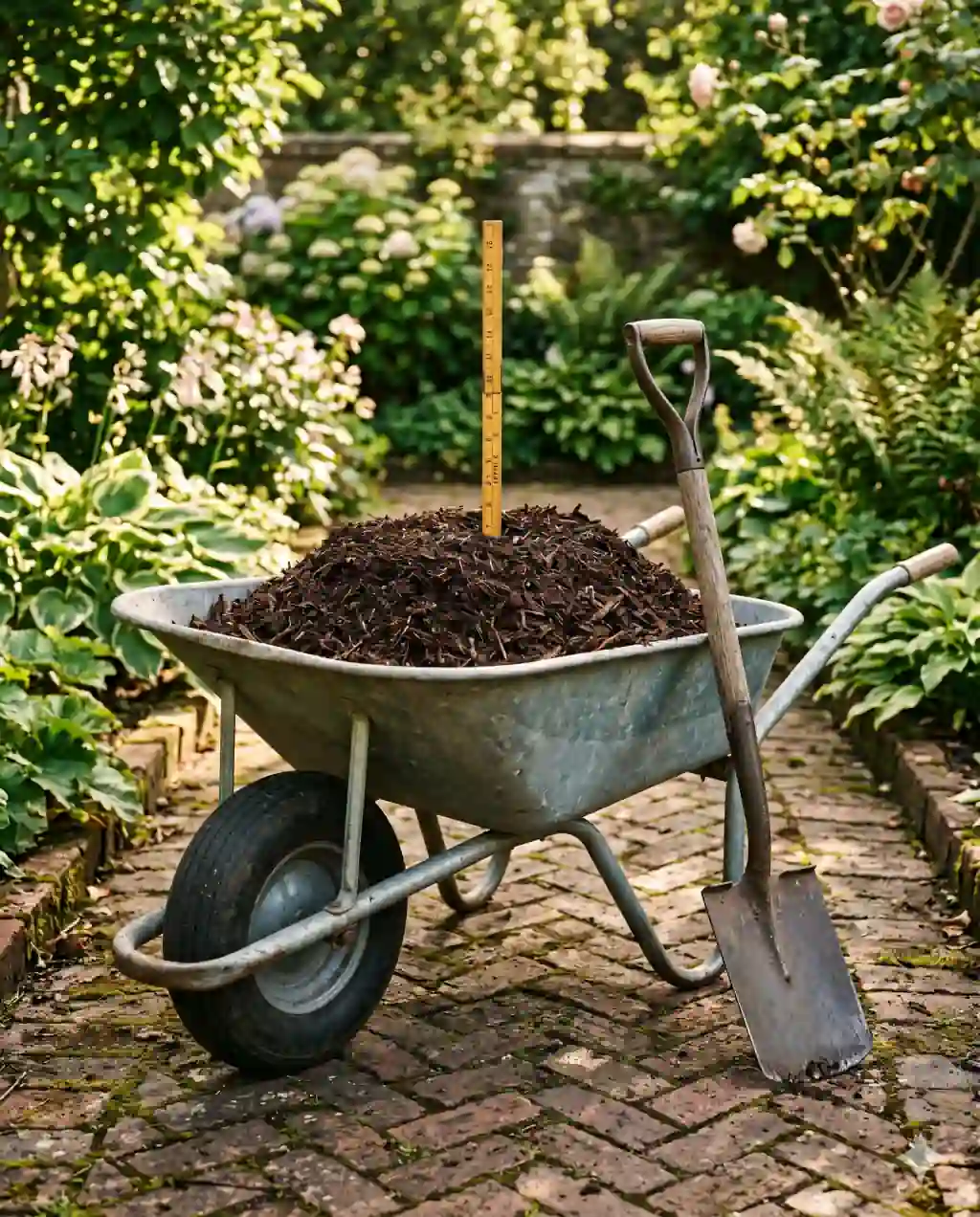
A galvanized wheelbarrow piled high with dark shredded mulch, a yellow carpenter's ruler standing upright in the mulch, and a spade leaning against the barrow.
Photograph for MulchCalc.
The worksheet

Do the
math here.

Enter dimensions in the units you measured in. The page does the converting — cubic feet, cubic yards, bag counts, and price — without sending your numbers anywhere.

Which volume unit for which job

Match the unit to the job size. The conversions are mechanical (27 cu ft = 1 cu yd, 1 cu ft ≈ 28.3 L), but the right reporting unit depends on how mulch will be delivered and counted.

Job sizeBest unit to order inWhyTypical buy
Under 6 cu ftCubic feet (bags)Below bulk minimum, sold by bag2–3 bags of 2 cu ft
6–25 cu ftCubic feet (bags)Bulk delivery fee eats savings3–13 bags
25–80 cu ftCubic yardsCrosses bulk break-even at ~3 cu yd1–3 cu yd bulk
80+ cu ftCubic yardsFree-delivery threshold reached3+ cu yd bulk
Metric / EU jobLitersPallets ship in 50/70/80 L bags10–30 metric bags
Container / potLiters or quartsPotting mulch sold by liter10–50 L bags

The settling buffer most calculators skip

Organic mulch settles 15–20% in the first 30 days. That's why our calculator and most extension services recommend adding a 10% buffer to the raw volume — it leaves you with the depth you actually wanted after settling, not the depth you measured on installation day.

USDA Forest Service field studies indicate that organic mulch volume can decrease by 15–25% in the first season due to settling and microbial decomposition, supporting the common 10% over-order buffer recommended by landscape practitioners.
— Source: USDA Forest Service

The unit conversions you'll need on receipt day

  • 1 cubic yard = 27 cubic feet. Memorize this; everything else follows.
  • 1 cubic yard ≈ 765 liters ≈ 0.765 cubic meters. Useful when comparing US bulk to metric pallets.
  • 1 cubic foot ≈ 28.3 liters ≈ 7.48 US gallons. The bag-to-watering-can conversion.
  • 1 cubic meter ≈ 1.31 cubic yards ≈ 35.3 cubic feet. Standard European bulk unit.
  • 13.5 bags of 2 cu ft = 1 cubic yard. The shopping-cart conversion.
  • 9 bags of 3 cu ft = 1 cubic yard. Cleanest math; what landscapers prefer.

Worked example: a 200 sq ft mixed bed

Why depth matters as much as area

Two beds with the same volume can have radically different footprints. A 100 sq ft bed at 3 in depth is 25 cu ft — exactly the same mulch order as a 50 sq ft bed at 6 in depth. Your supplier doesn't care how the volume was distributed; they ship volume.

Practical implication: when you have leftover mulch from a previous job, you can spread it deeper on a smaller bed rather than driving back for a fresh load. Cornell Bulletin 245 caps organic mulch at 4 inches over established root zones — beyond that, oxygen exchange to the roots drops noticeably.

Reader Letters

Frequently asked questions

How do I convert square footage to volume?+

Multiply by depth in feet. 100 sq ft × 0.25 ft (3-inch depth) = 25 cu ft. Divide by 27 to get cubic yards (0.93 cu yd) or multiply by 28.3 to get liters (708 L). The calculator runs all three at once.

What's the volume of a 1 cubic yard mulch order?+

27 cubic feet, roughly 765 liters, or 0.765 cubic meters. Covers 108 sq ft at 3-inch depth, 162 sq ft at 2-inch depth, or 81 sq ft at 4-inch depth. The most common bulk delivery minimum in the US.

How many cubic feet in a yard of mulch?+

Exactly 27. This is a universal conversion: 1 yard cubed equals 27 cubic feet regardless of material. It's the single most useful number to memorize for any landscaping math.

How do bags relate to volume?+

Bagged mulch in the US is sold in 2 or 3 cu ft sizes. 13.5 bags of 2 cu ft = 1 cu yd; 9 bags of 3 cu ft = 1 cu yd. In Europe, common bag sizes are 50, 70, and 80 liters.

What's the volume of 50 liters?+

50 liters ≈ 1.77 cubic feet ≈ 0.065 cubic yards. Standard metric bag size in the EU and Asia. About 15 of these bags equal 1 cubic yard.

Should I order exactly the calculated volume?+

No — add 10% for settling and edge loss. USDA Forest Service data shows organic mulch loses 15–25% volume in the first season. Bagged orders round up automatically; bulk orders should add about 0.1 cu yd per yard ordered.

How deep should I spread the mulch?+

3 inches is the standard for ornamental beds (Cornell Bulletin 245). Drop to 2 inches over seedlings or herb beds; raise to 4 inches for high-traffic edges. ANSI A300 caps tree-ring mulch at 4 inches to protect bark and root-zone oxygen exchange.

Does mulch type change the volume math?+

No — volume is volume. What changes is weight (rubber mulch is double the weight of bark per cubic yard) and compaction rate (fine-shredded settles faster than nuggets). The cubic-foot count stays the same.