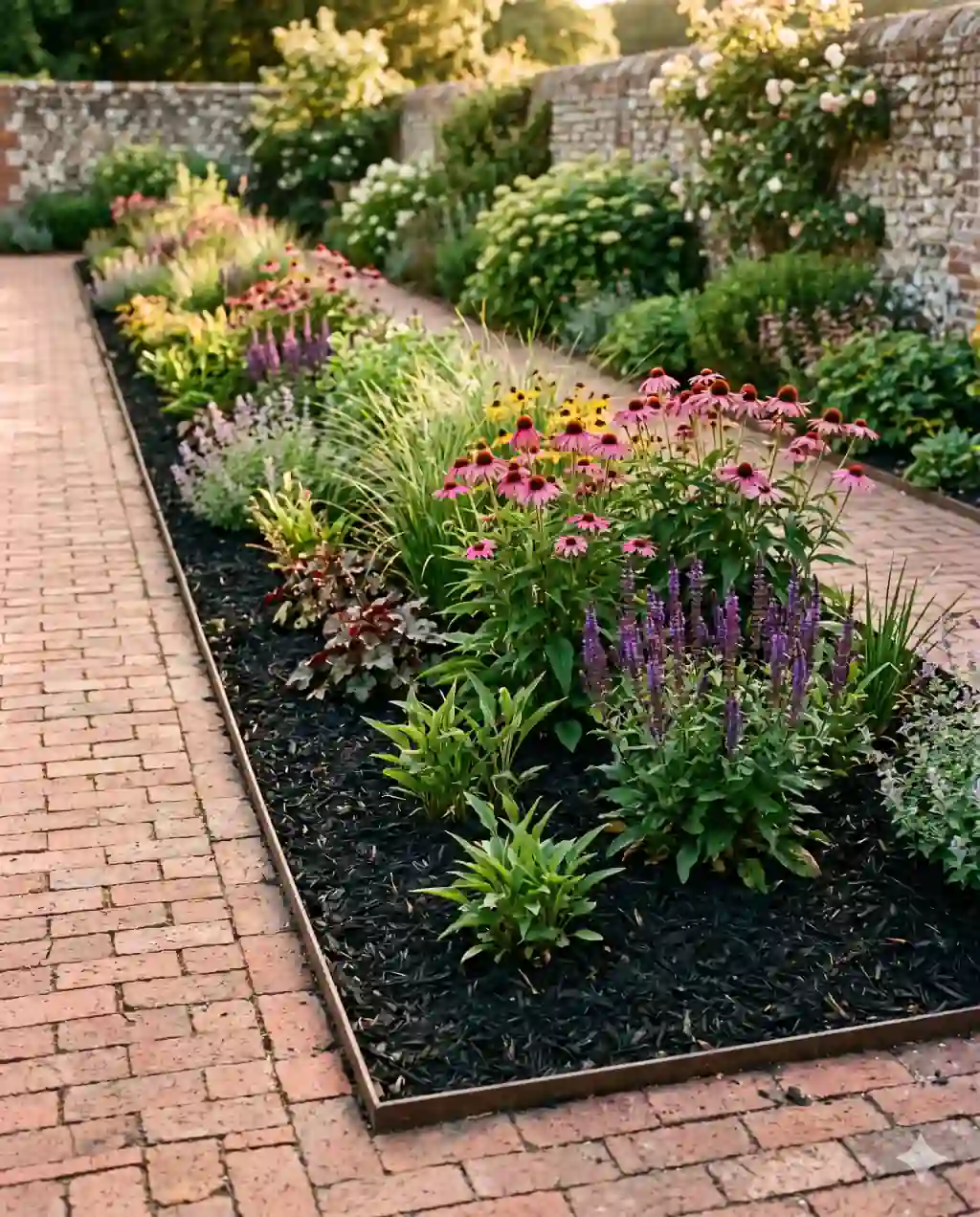
Start with a real bed: the 12 × 8 ft border
Every formula on this page derives from that single example. If you can walk through the 12 × 8 math by hand, you can size any rectangle in the yard.
Cornell Cooperative Extension recommends a 2-to-4-inch organic mulch layer for most ornamental beds — enough to suppress weed germination without smothering crown tissue or restricting gas exchange at the soil surface.
Why a small measurement error costs $30
A bed homeowners guess is 8 × 12 ft when it's really 9 × 14 ft is off by 31% in area — enough to send you back to the garden center mid-project, or to leave four unopened bags in the garage until next April.
Tape the long edge first, then drop perpendiculars to capture the short edge. Round to the nearest half-foot — anything tighter than that is false precision once the mulch settles.
The conversion chain, step by step
- Measure length and width in feet; multiply for square feet.
- Choose depth in inches; divide by 12 to convert to feet.
- Square feet × depth-in-feet = cubic feet.
- Divide cubic feet by 27 to get cubic yards (the bulk unit).
- Divide cubic feet by 2 (or 3) to get the number of 2 cu ft bags (or 3 cu ft bags).
- Add a 10% buffer for settling and edge spillover before rounding up.
Common rectangular bed sizes at 3-inch depth
| Bed size (ft) | Area (sq ft) | Volume (cu yd) | 2 cu ft bags | Bulk cost @ $40/yd |
|---|---|---|---|---|
| 4 × 8 | 32 | 0.30 | 4 | $12 |
| 6 × 10 | 60 | 0.56 | 8 | $22 |
| 8 × 12 | 96 | 0.89 | 12 | $36 |
| 10 × 20 | 200 | 1.85 | 25 | $74 |
| 12 × 24 | 288 | 2.67 | 36 | $107 |
| 16 × 32 | 512 | 4.74 | 64 | $190 |
Rows assume a 10% settling buffer is already included in the bag count. Subtract roughly 8% from area for any large hardscape feature (stepping stones, a birdbath base) above 10 sq ft.
When to split the rectangle in two
If your bed has any L-shape, peninsula, or curved tail, you'll land within 2% by splitting it into two or three rectangles and summing the results. The irregular mulch calculator is built for this — add zones and it sums automatically.
- L-shape against a corner of the house → two rectangles
- U-shape around a patio → three rectangles
- Rectangle with a half-circle bump on one end → rectangle + circle/2
- Rectangle with a triangular wedge cut off → rectangle minus triangle
