Trapezoid

Trapezoidal Mulch Calculator

A 9 × 5 ft fence-edge trapezoid 4 ft deep — the bed that runs from a 90° corner toward an angled property line — comes out to exactly 28 sq ft of mulch coverage, or 7 cu ft at the standard 3-inch depth. This is the most common trapezoid shape in residential landscaping, and almost nobody measures it correctly the first time. The math: ½ × (parallel side A + parallel side B) × perpendicular height.
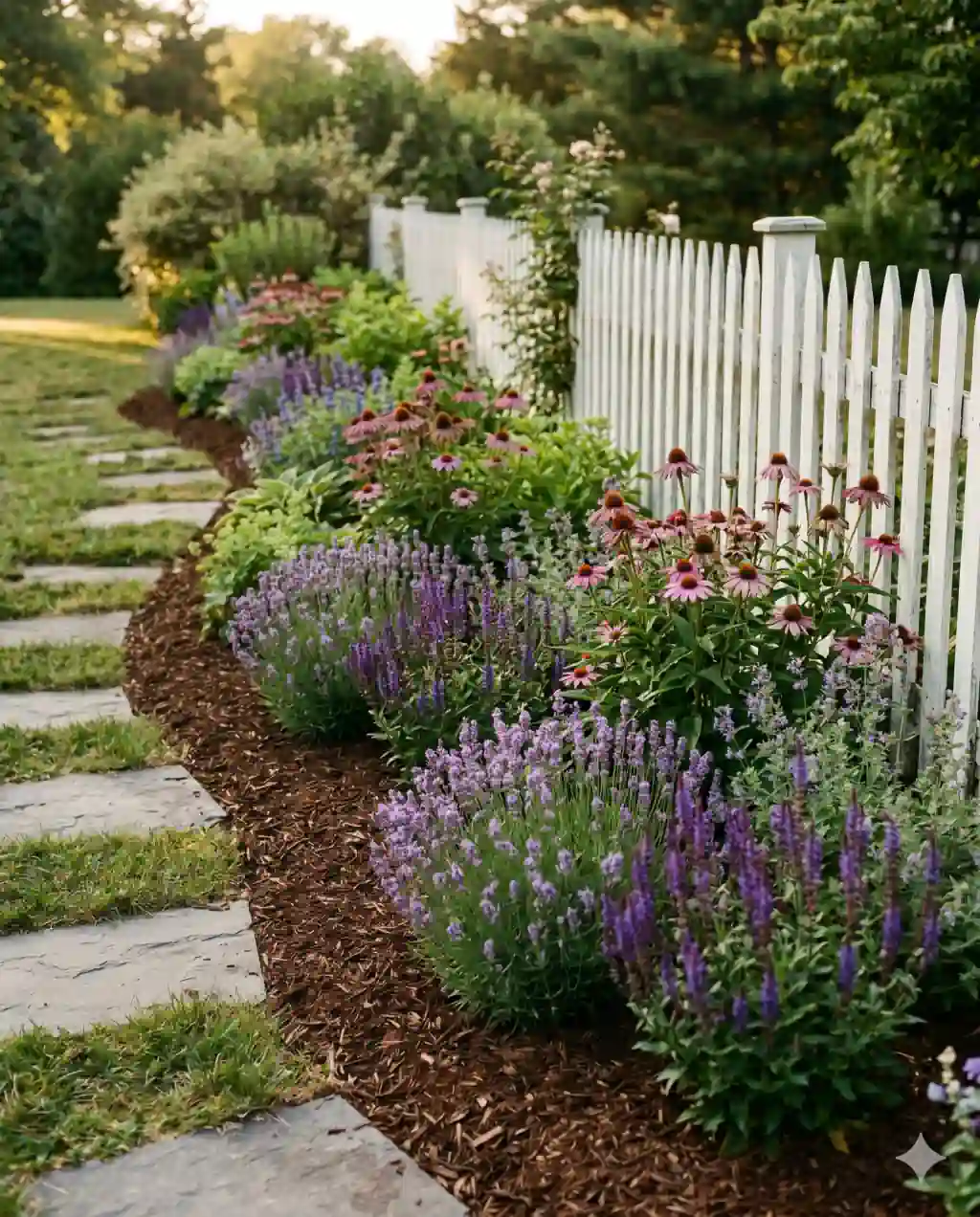
A trapezoidal planting bed running along a white picket fence, narrower at one end and wider at the other, freshly mulched with coneflowers, lavender, and sage.
Photograph for MulchCalc.
The worksheet

Do the
math here.

Enter dimensions in the units you measured in. The page does the converting — cubic feet, cubic yards, bag counts, and price — without sending your numbers anywhere.

Worked example: a fence-corner trapezoid

The key step most homeowners get wrong is the height. The height is the perpendicular distance between the two parallel sides — not the slant side. If your tape runs along the angled edge, you've measured the slant and the area will come out 10–20% too high.

Deriving the formula from the example

The trapezoid formula is just the average-width-times-height shortcut: Area = ½ × (a + b) × h, where a and b are the parallel sides and h is the perpendicular gap between them. The ½ is doing the averaging.

Reading it back: a 9 × 5 ft trapezoid is equivalent in area to a 7 ft wide rectangle of the same height. That's why the result (28 sq ft) is exactly what you'd get for 7 × 4 — the average of 9 and 5 is 7.

Where trapezoids show up on real lots

  • Driveway transitions. A planting strip runs along the driveway and tapers to meet a sidewalk or fence at an angle.
  • Property-line beds. Many lots have angled rear boundaries; foundation beds become trapezoidal where they wrap around the angle.
  • Slope tapers. Hillside beds narrow as elevation drops, creating a natural trapezoid along the contour line.
  • Corner-cut HOA strips. Curb-side beds where the road bends at an intersection — almost always trapezoidal.

Quick-reference area table

Side A (ft)Side B (ft)Height (ft)Area (sq ft)Cu ft at 3 in
643153.75
854266.5
954287.0
10654010.0
12866015.0
1510810025.0

When to split into simpler shapes

  1. Sides not parallel within 15°. Split into a rectangle plus 1 or 2 triangles, sum the areas. The irregular mulch calculator does this automatically.
  2. More than four sides. Any pentagonal or hexagonal bed: decompose into triangles using the diagonal method.
  3. Curved parallel side. Approximate the curve with three straight segments, treat as three small trapezoids end-to-end.
  4. Heavily sloped ground. Use the slant length as your perpendicular height only when slope is under 5%; above that, project to horizontal.

Reader Letters

Frequently asked questions

How do I find the height of a trapezoid?+

Drop a tape perpendicular from one parallel side to the other. That perpendicular distance is the height — not the slant edge. A carpenter's square or a string line at 90° to one parallel side gives you the right reference line in under a minute.

What if my parallel sides aren't actually parallel?+

Measure both 'parallel' sides anyway and treat them as parallel. As long as they're within 15° of true parallel, the formula gives a workable estimate (within 5%). Beyond 15°, split into a triangle plus a rectangle and use the irregular calculator.

How much mulch for a typical driveway trapezoid?+

A 9 × 5 ft trapezoid 4 ft deep is 28 sq ft. At 3-inch depth: 7 cu ft = 4 bags of 2 cu ft, about $18 at 2026 prices. Add 10% for settling and you still land on 4 bags.

Can I use this for an isosceles trapezoid?+

Yes — the formula works for any trapezoid regardless of symmetry. The two slant sides being equal doesn't change anything; only the parallel sides and the perpendicular height feed the math.

What about a 4-sided bed with no parallel sides?+

That's a general quadrilateral, not a trapezoid. Split it with a diagonal into two triangles, calculate each with ½ × base × height, and add. The triangular mulch calculator runs both halves for you.

Best edging for trapezoidal beds?+

Steel edging cuts cleanly along straight angles; flexible plastic works better on curved sides. Skip rigid pavers on angled runs — they create visible gaps at every joint. Penn State's bulletin lists steel as the longest-lasting option at 12–15 years.

Does slope affect the trapezoid area?+

Yes. If the bed sits on a hillside steeper than 5%, the tape-measured length over-estimates the horizontal area. Convert by multiplying by cos(slope angle), or measure the horizontal projection directly with a level tape.

How do I lay out a trapezoid on bare soil?+

Stake the four corners, run a string between each pair, then spray-paint along the strings. Verify perpendicular height with a carpenter's square at any point along the shorter parallel side before you start digging.