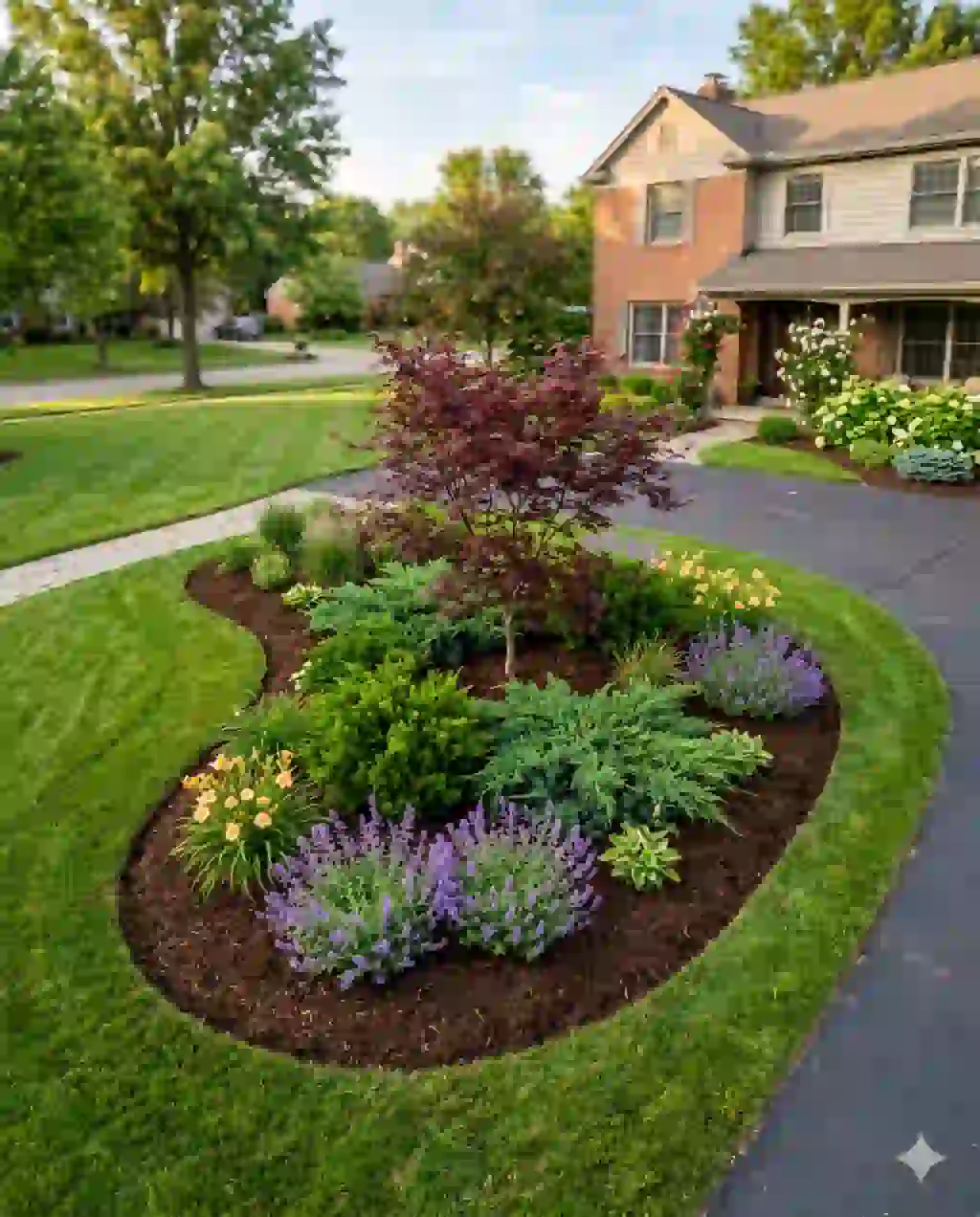
Drei Fehler, die eine Nierenbeet-Bestellung sprengen
Geschwungene Inselbeete sind nachsichtig zu Pflanzen und gnadenlos zur Mathematik. Fast jede Überbestellung lässt sich auf dieselben drei Fehler zurückführen:
- Den umschließenden Rahmen messen, nicht das Beet. Ein 12 × 8 ft umschließendes Rechteck sind 96 sq ft. Die Nierenform darin liegt näher bei 75 sq ft — eine Lücke von 22 %.
- Die Einbuchtung vergessen. Die konkave Seite der Bohne entfernt bei einem typischen 10-ft-Beet weitere 4–8 sq ft. Die Kurve als volles Oval zu behandeln, zählt diese Fläche doppelt.
- Für den breitesten Punkt kaufen. Tiefe und Sackanzahl sollten der durchschnittlichen Breite folgen, nicht der Wölbung. Für den breitesten 4-ft-Abschnitt zu bestellen, heißt überschüssiges Material zurück in die Garage zu schleppen.
Eine Nierenform auf Papier annähern
Die sauberste Mathematik behandelt ein Nierenbeet als Oval, reduziert um einen Einbuchtungsfaktor. Der 0,78-Koeffizient (≈ π/4) kommt vom Einbeschreiben der Bohne in ihr umschließendes Rechteck.
| Länge × Breite | Umschließendes Rechteck | Nierenfläche (× 0,78) | Cu ft bei 3 Zoll |
|---|---|---|---|
| 8 × 5 ft | 40 sq ft | 31 sq ft | 7.8 |
| 10 × 6 ft | 60 sq ft | 47 sq ft | 11.7 |
| 12 × 8 ft | 96 sq ft | 75 sq ft | 18.8 |
| 14 × 9 ft | 126 sq ft | 98 sq ft | 24.5 |
| 16 × 10 ft | 160 sq ft | 125 sq ft | 31.3 |
Für stark gelappte Bohnen (Einbuchtung mehr als 25 % der Breite) den Koeffizienten auf 0,72 senken oder das Beet in zwei überlappende Ovale teilen und die Überlappung abziehen.
Rechenbeispiel: eine 12 × 8 ft Vorgartensinsel
Die Kurve anlegen, bevor du misst
- Gartenschlauch-Methode. Die Bohne mit einem 50-ft-Schlauch auslegen, sie von der Straße ansehen, einstellen bis beide Lappen ausbalanciert sind, dann mit Sprühfarbe markieren.
- Drei-Pfähle-Methode. An den zwei Endpunkten und der Einbuchtung Pfähle einschlagen; das entstehende Dreieck rahmt das Beet für die Maßbandmessung.
- Mindestbreite 3 ft. Darunter wirkt das Beet wie ein Weg, nicht wie eine Pflanzfläche — und du verlierst den geschichteten Pflanzeneffekt.
- Einbuchtung zur Rasenseite. Konkave Kurve zum Betrachter; konvexe Kurve zum Haus. Das ist die visuelle Regel der Landschaftsdesigner.
Mulchtyp und Auffrischtakt für geschwungene Beete
Kurven betonen die Kante, also zählt die Farbe mehr als bei einem rechteckigen Fundamentstreifen. Gefärbtes Hartholz hält seinen Farbton 8–10 Monate; natürlicher geschredderter Hartholzmulch verblasst in 4–6 Monaten zu Silbergrau, wirkt aber unter Laubbäumen waldartiger.
- Sonnige Vorgärten: braun oder schwarz gefärbtes Hartholz, jährlich im Frühjahr mit 1-Zoll-Auflage erneuert.
- Schattige Nierenbeete unter Bäumen: natürlicher geschredderter Hartholzmulch, 2 Zoll Tiefe — Penn State Extension empfiehlt, organischen Mulch über etablierten Wurzeln unter 3 Zoll zu halten.
- Küsten- oder windige Standorte: schwerere Kiefernrindenstücke widerstehen dem Abwehen an offenen Lappen; fein geschredderten Mulch vermeiden.