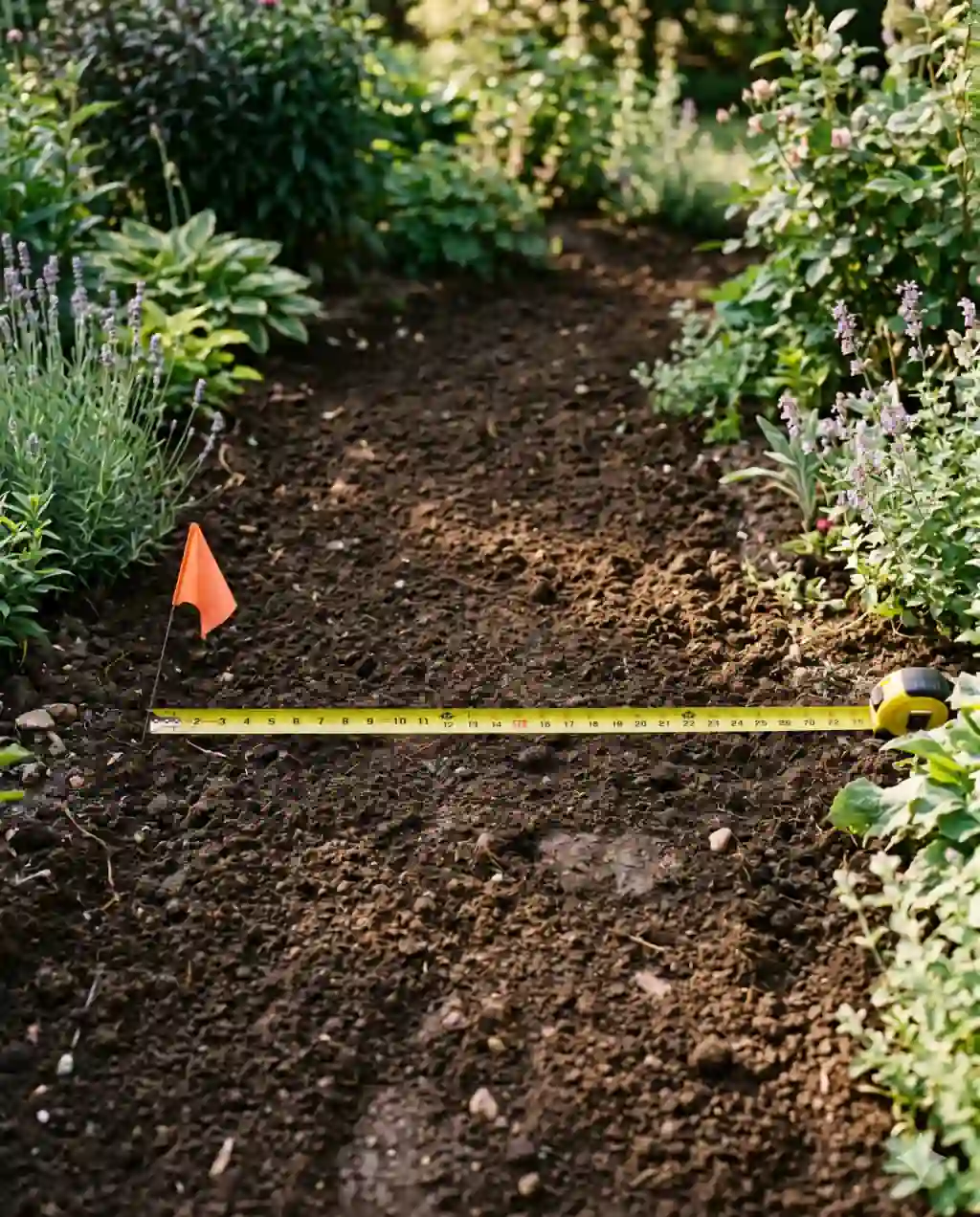
Five steps to a tape-measured square footage
- Sketch the bed on paper first. Walk the perimeter, note corners and curves. A rough sketch — not a measured drawing — prevents you from missing a section once you start taping.
- Decompose into basic shapes. Every bed reduces to rectangles, triangles, circles, and trapezoids. An L-shape is two rectangles; a kidney is an oval minus a chunk; a corner curve is a quarter-circle.
- Tape each shape's defining dimensions. Rectangle: length × width. Circle: diameter (not radius — easier to tape). Triangle: base × perpendicular height. Use a 50 or 100 ft reel tape, not a 25 ft retractable.
- Calculate each shape's area, then sum. Rectangle: L × W. Circle: π × (d/2)². Triangle: ½ × b × h. The calculator does this for you, or do it on paper for L-shapes with more than 3 sections.
- Cross-check by pacing the perimeter. Pace count × your calibrated stride gives a rough perimeter estimate; compare it with your tape sum. If the results differ clearly, measure again with the tape.
Decomposing L-shapes, U-shapes, and odd geometry
L-shaped foundation strips are the single most common 'irregular' bed in suburban landscaping. Treat any L as two rectangles meeting at a corner — never as one big rectangle with a notch.
Area formulas by shape
| Shape | Formula | Example | Area (sq ft) |
|---|---|---|---|
| Rectangle | L × W | 10 × 6 ft | 60 |
| Square | side² | 5 × 5 ft | 25 |
| Circle | π × r² | 6 ft diameter (r = 3) | 28.3 |
| Triangle | ½ × b × h | 8 × 6 ft | 24 |
| Trapezoid | ½ × (a+b) × h | 9 + 5 × 4 ft | 28 |
| Oval | π × (L/2) × (W/2) | 10 × 6 ft | 47 |
| Kidney | 0.78 × L × W | 12 × 8 ft | 75 |
Pacing as a backup check
- Calibrate your stride first. Mark 20 ft with a tape, walk it normally, count steps. Divide 20 by step count to get your true stride length.
- Pace each side twice. Once in each direction — averages out stride variation on slope.
- Round corners count. Add roughly 1 pace per 90° turn to capture the rounded path.
- Cross-check against tape. Pacing gives a rough estimate. If it differs clearly from the tape result, re-measure and use the tape measurement for the final order.
What to subtract — and what to leave in
Plants don't displace meaningful mulch volume; mulch goes around their stems and trunks. Hardscape elements do.
- Keep in area: small shrubs, perennials, bulbs, ground cover. Mulch flows around their bases.
- Subtract from area: stepping stones over 12 inches square, large boulders, concrete pavers, fixed sculptures.
- Rule of thumb: only subtract hardscape that covers more than 10% of the bed area. Below that, the standard 10% over-order buffer absorbs it.
- Tree trunks: for the tree-mulch calculator, subtract a 6-inch dry buffer ring around the trunk per ANSI A300 — but for sq-ft calc, just include it.