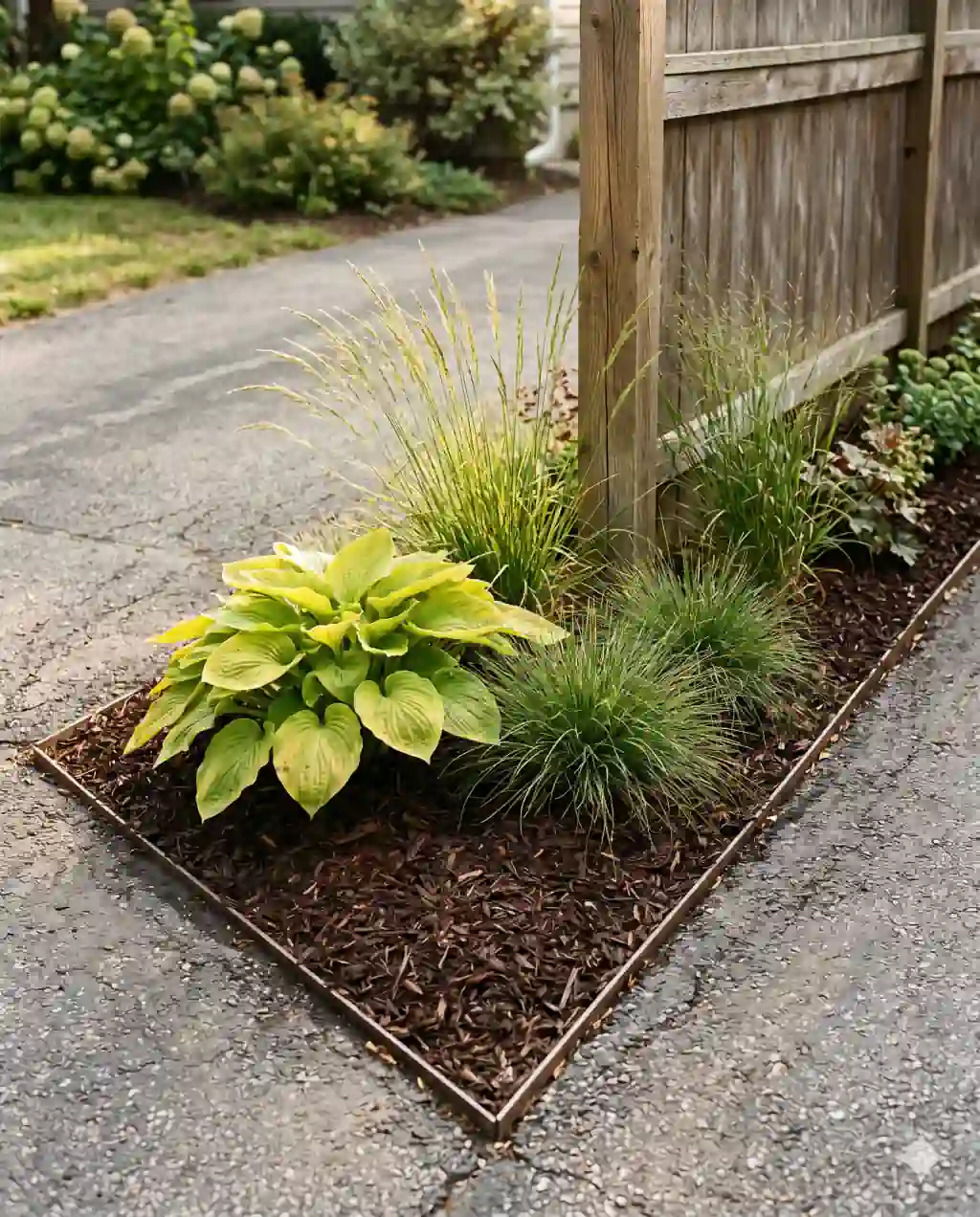
Triangle vs rectangle: where the 50% overshoot comes from
A triangle always covers exactly half the area of the rectangle that bounds it. That's a one-line geometric fact, but it has a real-world consequence: anyone who eyeballs a corner wedge as "about a 6 × 4 area" and orders rectangular volume buys twice the mulch they need.
Triangle vs irregular: when each tool wins
| Bed situation | Use triangle | Use irregular | Why |
|---|---|---|---|
| Three clean straight edges meeting at points | Yes | — | ½ × base × height resolves in one step |
| Wedge with one curved side (e.g. a path edge) | Approximate | Better | Irregular zones model the curve more accurately |
| Right-triangle corner where two walls meet | Yes | — | Base and height are the two walls themselves |
| Bed with 4 sides, two parallel (trapezoid) | — | Yes | Split into rectangle + triangle or use irregular |
| Triangle with a planted island in the middle | Yes, then subtract | — | Subtract the island as a separate small rectangle |
Rule of thumb: if you can name three corners and measure two straight sides between them, the triangle calculator is faster and more accurate than approximating with rectangles.
The formula, applied to a real corner
Area = ½ × base × height. The base is whichever straight side you measure first; the height is the perpendicular distance from that side to the opposite corner. The formula doesn't care whether the triangle is right, acute, or obtuse — the perpendicular drop is what matters.
Common corner triangles at 3-inch depth
| Base × height (ft) | Area (sq ft) | Volume (cu ft) | 2 cu ft bags | Cubic yards |
|---|---|---|---|---|
| 3 × 3 | 4.5 | 1.1 | 1 | 0.04 |
| 5 × 4 | 10.0 | 2.5 | 2 | 0.09 |
| 8 × 6 | 24.0 | 6.0 | 3 | 0.22 |
| 10 × 8 | 40.0 | 10.0 | 5 | 0.37 |
| 12 × 10 | 60.0 | 15.0 | 8 | 0.56 |
| 16 × 12 | 96.0 | 24.0 | 12 | 0.89 |
When the angle isn't 90 degrees
- Tape the longest side and call it the base.
- Stand at the opposite corner; walk a tape to the base, keeping the line perpendicular by eye.
- Drop the tape where it crosses the base — that distance is the height.
- Multiply ½ × base × height. The formula handles acute, right, and obtuse triangles identically.
- For obtuse triangles where the height line lands outside the base, that's still the correct height — the formula doesn't change.
