Bags

Mulch Bag Calculator

At spring 2026 US prices, a 2 cu ft bag of standard hardwood mulch runs $3.50–$5.50 at big-box stores — about $1.75–$2.75 per cubic foot. Bulk delivered hardwood sits at $30–$50 per cubic yard, or $1.11–$1.85 per cubic foot. The break-even between bagged and bulk lands at almost exactly 40 bags, or 3 cubic yards. This calculator returns the bag count rounded up, then flags whether you've crossed the bulk break-even.
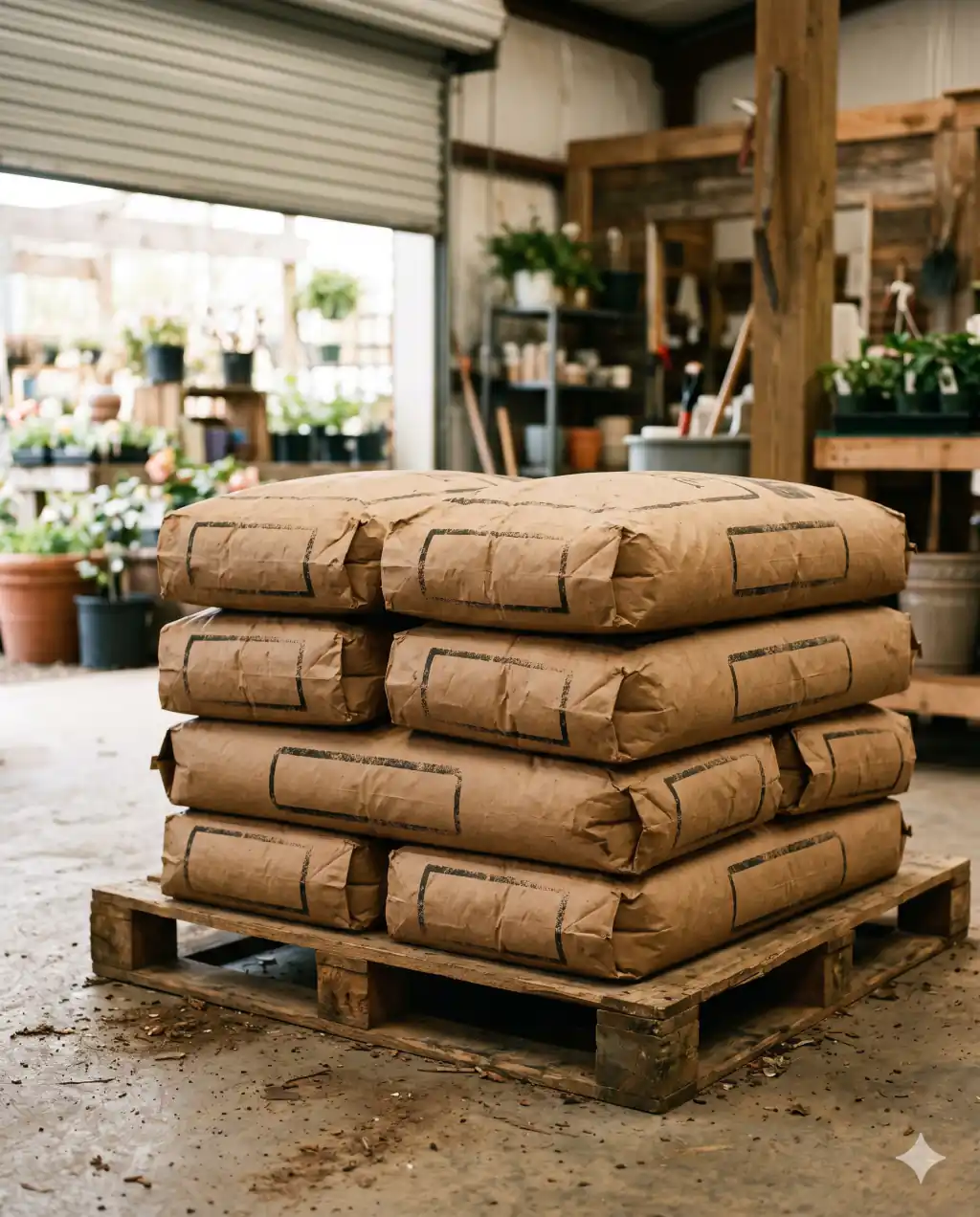
A neat stack of seven brown paper mulch bags on a wooden pallet at an independent garden center.
Photograph for MulchCalc.
The worksheet

Do the
math here.

Enter dimensions in the units you measured in. The page does the converting — cubic feet, cubic yards, bag counts, and price — without sending your numbers anywhere.

2026 bag pricing — what you'll actually pay

Bag prices vary by mulch type and region, but the US 2026 averages land in tight bands:

Bag size & typeTypical pricePer cu ftPer cu yd equiv
2 cu ft hardwood (natural)$3.50–$5.50$1.75–$2.75$47–$74
2 cu ft hardwood (dyed)$4.50–$7.00$2.25–$3.50$61–$95
2 cu ft cedar/cypress$5.00–$8.00$2.50–$4.00$68–$108
3 cu ft hardwood (natural)$5.50–$8.00$1.83–$2.67$50–$72
50 L pine bark (metric)€4.00–€6.00€2.26–€3.39€61–€92
0.8 cu ft rubber mulch$10.00–$15.00$12.50–$18.75$338–$506

Working backwards: when do bags stop making sense?

Take a typical $4.50 per 2 cu ft bag and a $40/cu yd bulk price with $60 delivery fee. The bagged cost grows linearly; the bulk cost has a $60 step-up plus a smaller slope. The crossover is at 40 bags.

Bag count for common bed sizes (3-inch depth)

Bed sizeSq ftCu ft2 cu ft bags3 cu ft bagsBag cost @ $4.50
5 × 5 ft256.343$18
6 × 10 ft601585$36
10 × 10 ft10025139$59
10 × 20 ft200502517$113
15 × 20 ft300753825$171
20 × 30 ft6001507550$338

Three real-world reasons to stay bagged anyway

Even above the bulk break-even, bagged sometimes wins on factors price-per-cubic-foot doesn't capture:

  1. Access. Stair-only or fenced backyards can't take a wheelbarrow from a bulk pile in the driveway. We've seen homeowners spend 6+ hours hauling 3 cu yd bucket-by-bucket through a 30-inch side gate.
  2. Color consistency. Bagged dyed mulch comes from controlled-batch coloring; bulk piles vary by load. For ornamental front-yard beds where color matters, bagged wins.
  3. Multi-color jobs. Black dyed front, natural brown back? Two bagged pallets beat two separate bulk deliveries every time.

Loading bags: how many fit in your vehicle

  • Sedan trunk: 8–10 bags of 2 cu ft. Tarp first; bag tears leak dye and bark fines.
  • SUV (rear seats down): 25–35 bags of 2 cu ft.
  • Pickup truck bed (6 ft): 50–60 bags. Stack two-high max for visibility.
  • Pickup truck bed (8 ft): 70–80 bags. Tie-down required at highway speed.
  • Trailer (5 × 8 ft utility): 90–110 bags. The cheapest way to move large bagged orders.

Above ~30 bags, it's usually faster and cheaper to schedule bulk delivery instead of running multiple store trips — even before you cross the cost break-even.

Reader Letters

Frequently asked questions

How many 2 cu ft bags of mulch make a cubic yard?+

13.5 bags. One cubic yard equals 27 cubic feet, and 27 ÷ 2 = 13.5. In practice buy 14 — stores don't sell half bags, and the extra covers the 10% settling buffer Cornell Bulletin 245 recommends.

How many 3 cu ft bags equal a cubic yard?+

Exactly 9 (27 ÷ 3 = 9). This is one reason landscapers prefer 3 cu ft bags: the math is clean and pallets stack at standard 50 or 60 bag counts that work out to whole-yard equivalents.

Is bagged or bulk mulch cheaper?+

Bagged costs $1.75–$2.75 per cubic foot in 2026; bulk costs $1.11–$1.85 delivered. The break-even sits at roughly 40 bags of 2 cu ft, or 3 cubic yards. Below 40 bags, bagged wins after the bulk delivery fee. Above 40, bulk wins by 30–50% per cu ft.

What if my volume is between bag counts?+

Always round up. Mulch settles 10–15% in the first 30 days (USDA Forest Service data), and stores can't sell partial bags. Ordering 12.3 bags? Buy 14 — the extra covers settling and edge loss.

Do bag sizes vary by brand or region?+

Yes. North American retail standardizes on 2 cu ft and 3 cu ft. Some premium brands sell 1 cu ft bags. European and Asian markets sell 50, 70, and 80 liter bags. Rubber mulch typically ships in 0.8 cu ft bags. This calculator handles all five formats.

Can I mix bag sizes?+

Yes — fill the bulk with cheaper 3 cu ft bags and top off with 2 cu ft bags for exact coverage. Compare per-cubic-foot prices at your store: a $7.50 / 3 cu ft bag ($2.50/cu ft) beats a $5 / 2 cu ft bag ($2.50/cu ft) for tie at price, but the larger bag means fewer trips.

How heavy is a 2 cu ft bag?+

35–45 lb for hardwood, slightly more for dyed varieties (40–50 lb) and rubber (50–60 lb). Manageable for one person on flat ground; consider a two-person lift on stairs or if you have back issues.

Do bags come with the 10% settling buffer baked in?+

No — bag sizes are post-decomposition free-fill volume, not installed depth. The calculator adds the 10% buffer to your bag count automatically; if you do the math by hand, multiply your raw bag count by 1.1 and round up.