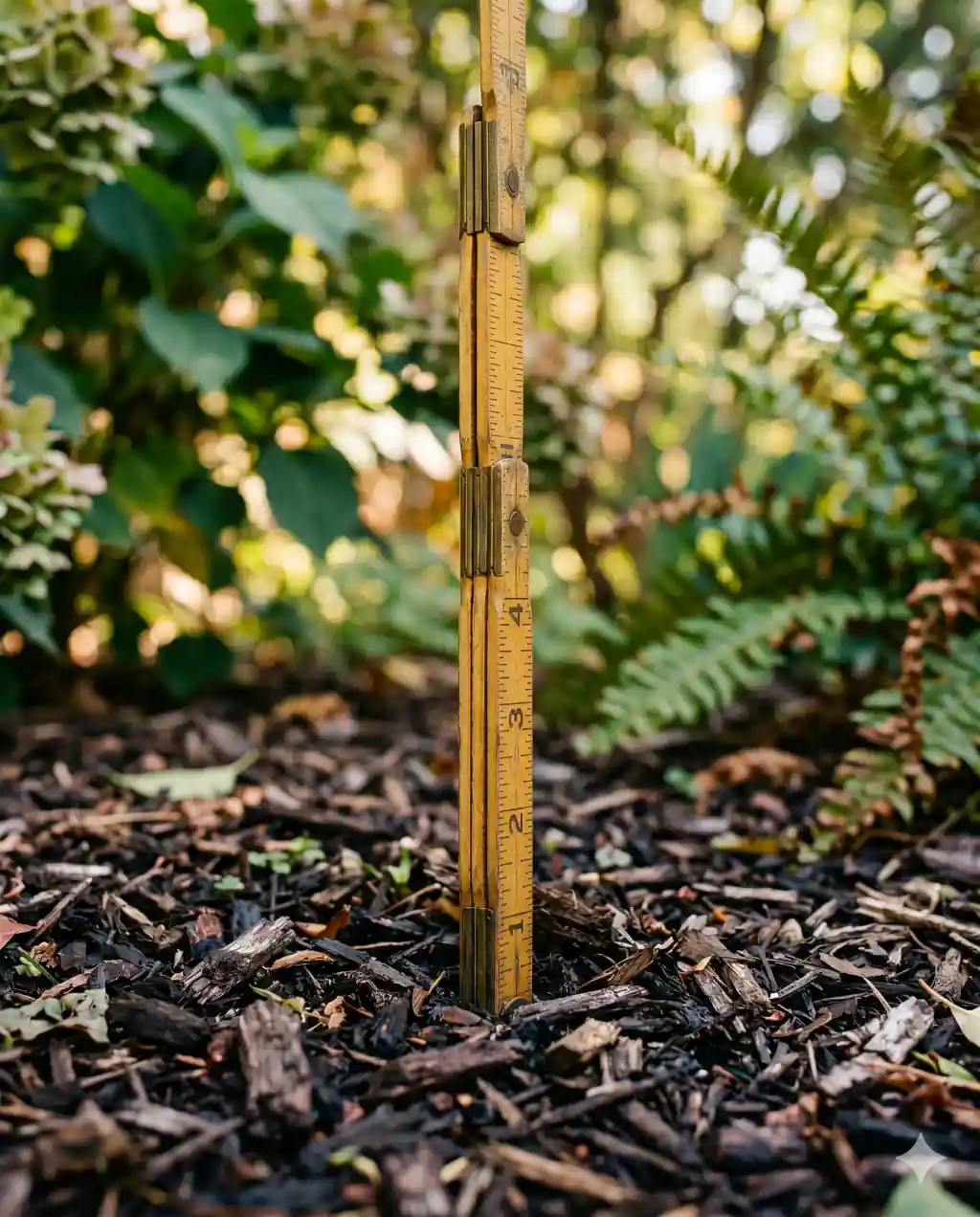
Tiefe nach veröffentlichter Norm
Es gibt keine einzelne "richtige" Mulchtiefe. Die richtige Antwort hängt davon ab, was der Mulch leisten soll, und jeder Hauptanwendungsfall hat eine geschriebene Norm dahinter. Zitiere die Norm in deiner Spezifikation oder deiner Hausbesitzervereinigungsanfrage und du eliminierst die meisten Streitigkeiten.
| Anwendungsfall | Tiefe | Regelnde Norm |
|---|---|---|
| Baumwurzelzone | 2–4″ (3″ typisch) | ANSI A300-2023 |
| Blumen- & Strauchbeete | 2–4″ (3″ ideal) | Cornell Cooperative Extension / RHS guidance |
| Gemüsegarten | 1–2″ | Iowa State Univ. Ext. guidance |
| Unkrautunterdrückung | 3–4″ | Penn State Extension |
| Gartenweg | 4–6″ | RHS guidance |
| Spielplatzoberfläche | Per certified product rating | CPSC 2025 + ASTM F1292/F2075 |
| Winter-Wurzelkrone | 3–6″ | University of Minnesota Extension |
Warum 3 Zoll der Standard für Zierbeete sind
Cornell Cooperative Extension und Penn State Extension guidance konvergieren beide auf einem 2–4-Zoll-Bereich mit 3 Zoll als typischer Empfehlung. Die Begründung beruht auf drei messbaren Effekten.
- Lichtblockierung. Die meisten Unkrautsamen brauchen 1–3 Photonen roten Lichts, um Keimung auszulösen. Drei Zoll organischen Mulches übertragen weit unter 0,01 % der einfallenden Sonnenstrahlung auf die Bodenoberfläche.
- Wurzelzonen-Atmung. Über 4 Zoll sinkt die Sauerstoffdiffusion zu Feinwurzeln unter 60 % der Nacktboden-Raten — anaerobe Bedingungen beginnen und Phytophthora wird zum Risiko.
Die Royal Horticultural Society empfiehlt eine Mulchtiefe von 5–7 cm um krautige Stauden und das Freihalten von Stängeln und Wurzelhals, um Feuchtigkeitsfäule zu vermeiden.
ANSI A300 — Baumtiefe und Vulkanprävention
ANSI A300-2023 — Tree Care Operations: Mulching ist die amerikanische Norm, mit der Baumpfleger arbeiten. Sie befasst sich speziell mit Baummulchen und ist konservativer als die allgemeine Zierleitlinie:
- Abschnitt 4.2.1 — Tiefe: 2–4 Zoll organischer Mulch, 3 Zoll typisch.
- Abschnitt 4.2.2 — Verjüngung: Auf 1 Zoll innerhalb von 6 Zoll vom Stamm reduzieren.
- Abschnitt 4.2.3 — Puffer: 2–3 Zoll nackten Bodens in direktem Kontakt mit der Rinde — niemals Mulchkontakt.
- Abschnitt 4.2.4 — Ausdehnung: Die Wurzelzone bis zur Traufkante abdecken, wo Standortbedingungen es erlauben.
ANSI A300-2023 legt fest, dass die organische Mulchtiefe um Bäume über der Wurzelzone 10 cm nicht überschreiten darf und am Stamm auf 2,5 cm verjüngt werden muss, mit 5–8 cm trockener Pufferzone um die Rinde.
Spielplatztiefe — ASTM F1292 und CPSC 325
Required depth is product-specific. Match the equipment fall height to the exact surfacing system's current ASTM F1292 critical-fall-height report, then use its tested installation and maintenance depth.
| Input | Source | Requirement |
|---|---|---|
| Equipment fall height | Equipment documentation or measurement | Record the highest applicable fall height |
| Surfacing critical fall height | Current ASTM F1292 product test report | Must meet or exceed equipment fall height |
| Installed depth | Certified product instructions | Use the stated installed and maintenance depth |
The 2025 CPSC handbook includes non-CCA wood mulch and wood chips as loose-fill options when the installed surface is impact-tested as required. EWF should comply with ASTM F2075; loose-fill rubber should comply with ASTM F3012. A material name alone does not establish ASTM F1292 performance.
Planungsreserve, Setzung und Pflege
Die Volumenformel beschreibt die Schicht in der eingegebenen Tiefe. Organischer Mulch kann sich zersetzen, verdichten oder verlagern; Ausmaß und Zeitpunkt hängen von Produkt, Standort, Klima, Handhabung und Pflege ab. Miss die vorhandene Schicht vor dem Nachfüllen und nutze den optionalen Puffer nur als projektspezifische Planungsreserve.