Rubber

Rubber Mulch Calculator

Rubber mulch is the most argued-about material in the residential landscape — three persistent myths drive most of the noise. It does run hot, but not as hot as people quote. It is not categorically toxic, but it does not belong near food crops. And it lasts 10–15 years, not the 50 the manufacturers advertise. This calculator sizes recycled-tire rubber for playgrounds, dog runs, and high-traffic accent zones, and fact-checks the claims that drive purchase decisions.
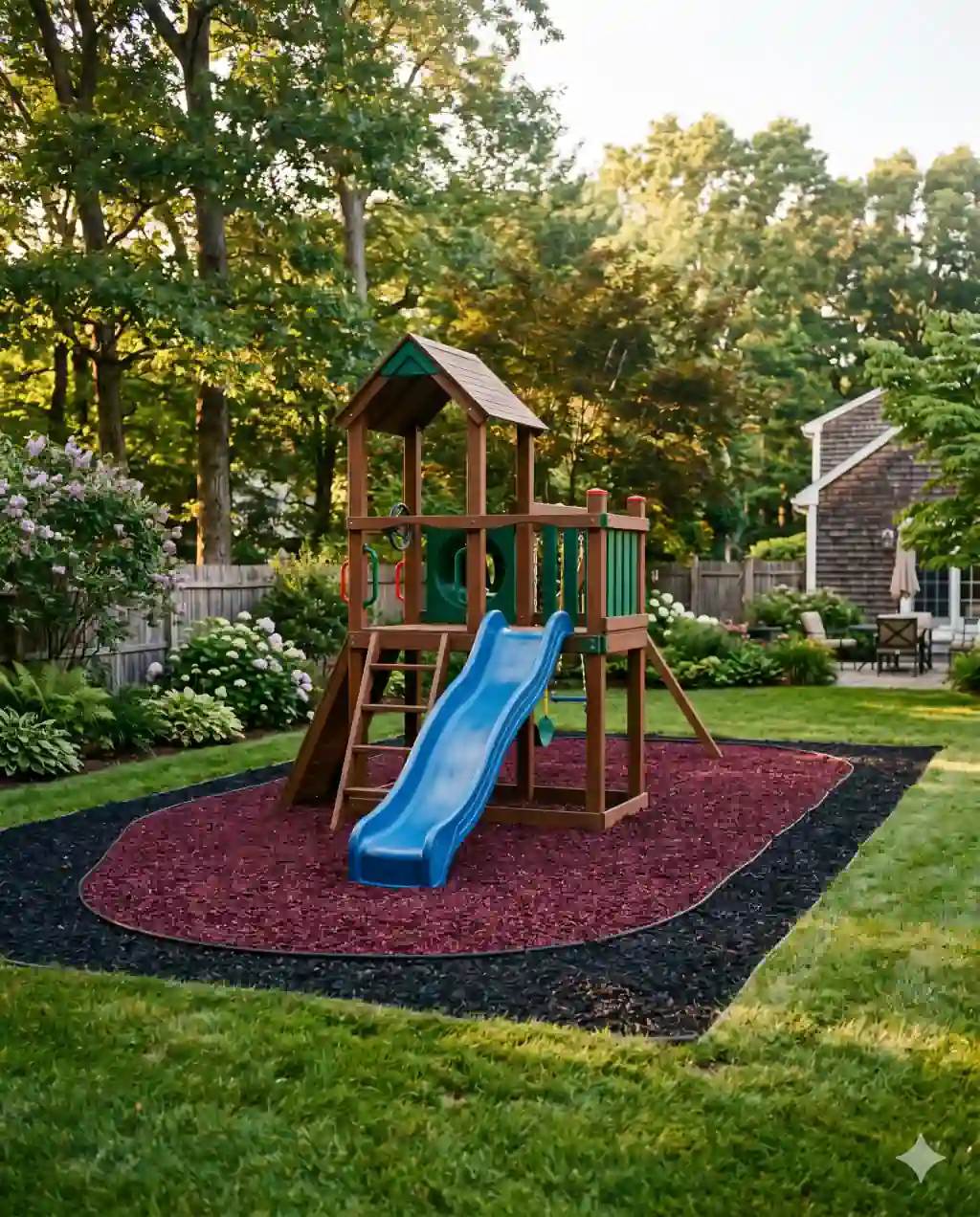
A residential backyard playground with a slide and climbing frame surrounded by rich burgundy red rubber mulch, with patches of black rubber mulch around the edges.
Photograph for MulchCalc.
The worksheet

Do the
math here.

Enter dimensions in the units you measured in. The page does the converting — cubic feet, cubic yards, bag counts, and price — without sending your numbers anywhere.

Three myths about rubber mulch — fact-checked

Before any purchase decision, sort the noise from the data. The three claims below dominate the residential-mulch conversation, and each has a different answer.

MythFactWhat you actually do about it
Rubber mulch is unbearably hot — won't grow anythingSurface temperature in full sun runs 5–10°F hotter than hardwood; root-zone temp 3 in below the surface runs 2–4°F warmer (Penn State 2019 study)Avoid it as the only mulch under heat-sensitive perennials in zones 8+; fine for playgrounds, dog runs, accent zones
Rubber mulch is toxic to children and plantsStudies on IPEMA-certified mulch (rubber meeting ASTM F3012 and F1292 leachate testing) find zinc levels safely below EPA Tier 1 soil-screening limits over a 10-year exposure. Non-certified mulch is a different story.Buy IPEMA-certified only; avoid uncertified bulk product; keep it out of vegetable beds regardless
Rubber mulch lasts foreverMarketing claims 50 years; real-world studies show 10–15 years before significant fragmentation, UV fade, and binder breakdown (US EPA tire-recycling 2021 report)Budget a full replacement at year 12; pull and remediate the underlying soil if zinc test results exceed 250 ppm

Where rubber actually wins — and where it loses

Rubber mulch has three genuine sweet spots and three genuine deal-breakers. Picking it for the right reason saves money over a decade; picking it for the wrong reason wastes 2–3× the cost of hardwood.

  • WIN — playgrounds: IPEMA-certified rubber meets ASTM F1292 fall-attenuation at 6 in (7 ft fall height) and 9 in (12 ft fall height) with no annual top-up
  • WIN — dog runs: doesn't get muddy, doesn't harbor parasites the way wood chips can, easy to hose off urine
  • WIN — high-traffic accent zones: around mailboxes, under spigots, in narrow side paths where wood compresses fast
  • LOSE — vegetable garden beds: zinc accumulation over 10 years exceeds the conservative threshold for leafy greens (Iowa State 2020 advisory)
  • LOSE — heat-stressed perennial beds in Sun Belt zones (8+): 3–5°F additional root-zone temp is the wrong direction in July
  • LOSE — short-term landscape installs: the 10-year breakeven only pencils out if you stay in the house; for < 5 year holds, hardwood is cheaper

Rubber mulch products marketed for playground use must be tested to ASTM F1292 at the manufacturer's stated installed depth; HIC and peak-g thresholds are evaluated at the equipment's critical fall height, not at a generic depth.
— Source: ASTM F1292

Worked example: a 20 × 16 ft play area

Same 320 sq ft area in IPEMA-certified EWF for comparison: 240 cu ft compacted × 1.25 install factor = 300 cu ft = 11.1 cu yd at $50–$70/cu yd bulk = $555–$777. EWF is $400–$600 cheaper today; rubber catches up over 10–12 years if you stay put. The decision pivots on house tenure, not on the materials themselves.

Disposal and end-of-life

Rubber mulch is the only landscape surface with a serious end-of-life problem. EWF biodegrades into soil; rubber does not. When the binder fails and fragments migrate, you have a remediation job — not a cleanup.

  1. Year 0–10: routine maintenance — rake high-wear zones, top-dress as needed
  2. Year 10–12: pull a 2-cup soil sample from under the wear zones; test for zinc and lead at a state extension lab ($25–$45)
  3. If zinc < 200 ppm: top-dress to depth and continue
  4. If zinc 200–250 ppm: remove top 4 in of rubber and 2 in of underlying soil; replace with fresh certified product on a fabric barrier
  5. If zinc > 250 ppm or lead detectable: full removal, soil remediation, and switch to a different surface
  6. Disposal: rubber is not municipal-waste friendly. Many counties run free tire-recycling drop-off events twice a year; otherwise commercial tire haulers charge $0.10–$0.20/lb. A 9 cu yd install weighs ~12,000–18,000 lbs.

Reader Letters

Frequently asked questions

How much rubber mulch do I need?+

Use the same area × depth formula as wood, but skip the settling buffer — rubber doesn't compact significantly. A 320 sq ft area at 9 in needs exactly 240 cu ft = 8.9 cu yd. Round up to 9 cu yd for delivery; the typical bulk minimum is 3 cu yd.

How long does rubber mulch last?+

10–15 years before significant degradation, per the U.S. EPA's 2021 scrap-tire study — not the 50 years manufacturers advertise. UV-stable formulations and IPEMA-certified product sit at the longer end; uncertified bulk runs 5–7 years before fading and fragmentation.

Is rubber mulch safe?+

IPEMA-certified rubber that meets ASTM F3012 leachate testing is documented safe for playgrounds and ornamental beds — zinc levels stay below EPA Tier 1 soil-screening limits over 10 years. It does not belong near vegetables or fruit; Iowa State Extension flags long-term zinc accumulation as a leafy-green safety risk.

How much does rubber mulch cost?+

$80–$150 per cubic yard bulk delivery in 2026 US (IPEMA-certified). Bagged: $10–$15 per 0.8 cu ft bag, which works out to $135–$200 per cu yd equivalent — bulk is the right call any time you need more than 2 cu yd.

Does rubber mulch fade?+

Quality UV-stable IPEMA-certified rubber fades 10–20% over 10 years and remains visually acceptable. Uncertified bulk product loses 40–60% of its color in 2–3 years and starts shedding pigment into soil — the visual deterioration is the most common reason for early replacement.

Can I mix rubber and wood mulch?+

Yes for separate-zone aesthetic effect (rubber accent ring inside a wood-mulched bed), but never blend them in the same square footage. The texture contrast reads as inconsistent maintenance, and the wood breaks down while the rubber doesn't — within a year the wood is half-decomposed and the visual integration is lost.

Does rubber mulch really get too hot?+

Penn State 2019 field data: surface temp runs 5–10°F hotter than hardwood in full sun; root-zone temp at 3 in below surface runs 3–4°F warmer. Real, but smaller than commonly quoted. Avoid as the sole mulch under heat-sensitive perennials in USDA zones 8+; fine for playgrounds and dog runs.

What happens at end of life?+

Year 10–12, pull a soil sample and test for zinc at a state extension lab ($25–$45). Below 200 ppm: top-dress and continue. Above 250 ppm: remove the rubber, scrape the top 2 in of soil, and switch surfaces. Disposal goes through county tire-recycling drop-offs or commercial haulers at $0.10–$0.20/lb — a 9 cu yd install weighs 6–9 tons.