How Much

How Much Mulch Do I Need?

Roughly 6.1 million people Google this exact question every spring in the US alone. The honest answer is four steps — measure, set depth, multiply, convert — and almost every overshoot we see in the field comes from skipping step two or four. Below is the universal procedure Cornell Cooperative Extension teaches Master Gardeners, with the bag and bulk math worked out so you can stop guessing.
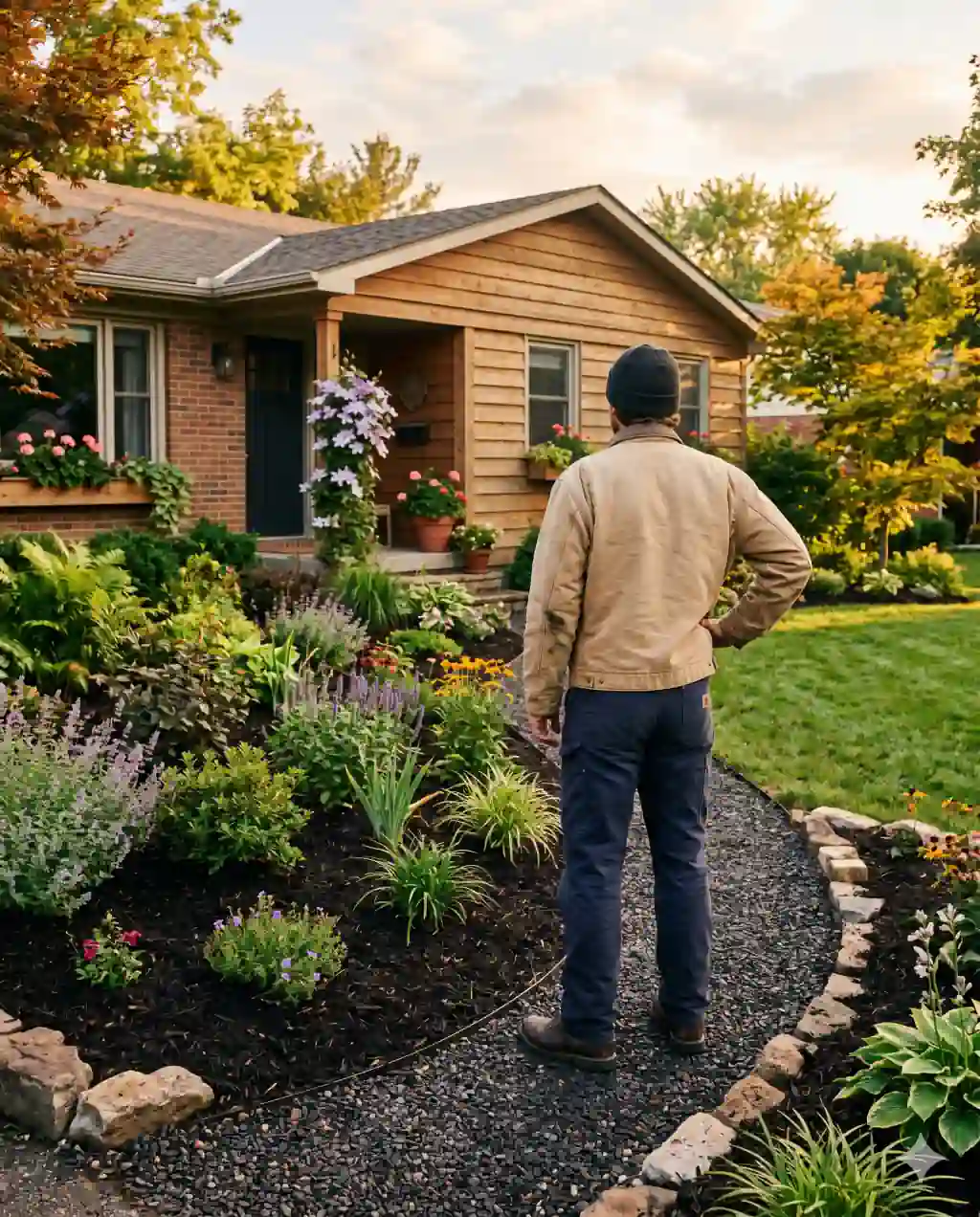
A person in dark canvas work pants standing back from a freshly mulched front yard with mixed beds, hand on hip, surveying the work.
Photograph for MulchCalc.
The worksheet

Do the
math here.

Enter dimensions in the units you measured in. The page does the converting — cubic feet, cubic yards, bag counts, and price — without sending your numbers anywhere.

The 4-step universal procedure

This is the procedure Cornell Cooperative Extension hands to Master Gardener trainees. It works for any bed shape and any unit system. The trick is to keep depth in the same unit as area — that is where 60% of homeowner errors start.

  1. Step 1 — Measure the area in sq ft. Rectangle: length × width. Circle: π × radius² (or 0.7854 × diameter²). Triangle: ½ × base × height. Irregular: divide into rectangles and triangles, sum the parts.
  2. Step 2 — Pick a depth and convert to feet. Inches ÷ 12 = feet. The four standard depths: 2" (0.17 ft) for vegetable beds, 3" (0.25 ft) for flower beds, 4" (0.33 ft) for weed suppression and tree rings, 6"+ (0.50 ft+) for playgrounds.
  3. Step 3 — Multiply for cubic feet. Area (sq ft) × depth (ft) = volume (cu ft). A 100 sq ft bed at 3" = 100 × 0.25 = 25 cu ft.
  4. Step 4 — Convert to bags or yards. Cubic yards: cu ft ÷ 27. 2 cu ft bags: cu ft ÷ 2. 3 cu ft bags: cu ft ÷ 3. Add 10% settling buffer and round up.
Cornell Cooperative Extension recommends a 2-to-4-inch organic mulch layer for most ornamental beds — enough to suppress germination of light-triggered weed seeds without smothering crown tissue or restricting gas exchange at the soil surface.
— Source: Cornell Cooperative Extension

Quick-reference: mulch needed for common bed sizes

These figures already include the 10% settling buffer recommended by University of Minnesota Extension (AG-FO-1115). Round up — partial bags do not exist.

Bed sizeSq ftCu yd @ 3″2 cu ft bags3 cu ft bags
4 × 8 raised bed320.3353
10 × 10 island1001.031410
6 ft tree ring280.34 @ 4″54
3 × 30 foundation strip900.92139
15 × 25 front yard3753.825235
1,000 sq ft full landscape1,00010.213892

Two worked examples — bag and bulk

The four mistakes we see most often

  • Skipping the unit conversion. Multiplying area (sq ft) by depth in inches produces a result 12× too large. Always convert depth to feet first.
  • Forgetting the buffer. Mulch settles 15–20% in 30 days (UMN Extension). Add 10% before rounding up to absorb settling plus edge loss.
  • Eyeballing bed size. Homeowner estimates run 15% short on average. Pace each dimension twice and average — adult stride is 2.5 ft for men, 2.2 ft for women.
  • Confusing bag sizes. 2 cu ft is the US default; 3 cu ft bags are 50% larger but visually similar. Always confirm the cubic-foot label before doing math.

Reader Letters

Frequently asked questions

How much mulch for a typical front yard?+

Most US suburban front yards carry 400–800 sq ft of mulched beds (tree rings, foundation strips, one or two islands). At 3-inch depth that is 3.7–7.4 cu yd — one bulk delivery for the whole yard, or roughly 50–100 bags of 2 cu ft.

How many bags for a 100 sq ft bed?+

At 3-inch depth: 100 × 0.25 = 25 cu ft = 12.5 bags of 2 cu ft. Round up to 14 with the settling buffer. Or 9 bags of 3 cu ft. Or one bulk cubic yard with a few cubic feet left over for top-up next month.

How much mulch for a tree ring?+

A 6 ft diameter ring is 28 sq ft. At ANSI A300's 4-inch depth (donut shape, tapered to 1 inch at trunk): 9.4 cu ft = 5 bags of 2 cu ft. An 8 ft ring at the same depth: 17 cu ft = 9 bags.

Should I order extra?+

Yes — 10% extra is the standard buffer. Mulch settles 15–20% in the first 30 days (UMN AG-FO-1115), edges spill, and uneven raking eats coverage. Half a leftover bag is far cheaper than a second store trip plus gas.

Is it better to over-order or under-order?+

Over-order by 10%. The marginal cost of one extra 2 cu ft bag is about $4.50; the cost of a second store trip is $8–$15 in gas and roughly 45 minutes of your day. Extra mulch keeps fine outdoors covered with a tarp until the next refresh.

How do I estimate without measuring?+

Pace it out — adult stride averages 2.5 ft (men) or 2.2 ft (women). Multiply your step count by stride length for each dimension. Pace each side twice and average to correct for uneven ground. Accuracy is typically within 10% on flat lawns.

Does the math change for non-rectangular beds?+

Only step 1 changes. Use π × r² for circles, ½ × base × height for triangles, and 0.785 × length × width for ovals. For freeform islands, divide into 2–3 simpler shapes, find each area, then sum. Steps 2–4 stay identical.

What if my supplier sells by liter or kilo?+

Multiply cu ft by 28.3 to get liters. Most metric markets (UK, EU, AU) sell mulch in 50, 70, or 80 liter bags. For weight, dry hardwood averages 12–15 kg per 50 L bag — useful for trunk-load planning.