Ce que dit vraiment ANSI A300-2023
ANSI A300-2023 — la norme nationale américaine pour Tree Care Operations: Mulching — est le document à partir duquel travaille tout arboriste certifié. Trois de ses spécifications importent pour les maths de cette page :
- Profondeur 2–4 pouces de paillis organique sur la zone racinaire.
- Dégagement d'écorce d'au moins 2–3 pouces entre paillis et tronc.
- Rayon d'anneau idéalement étendu jusqu'à la ligne d'égouttement, jamais inférieur à 3 ft pour un arbre établi.
Pourquoi le diamètre, pas le rayon — et pourquoi le doubler pique
Surface = π × (diamètre ÷ 2)². Pour une cuvette de 6 ft : π × 3² = 28,27 sq ft. Doubler le diamètre à 12 ft quadruple la surface à 113,10 sq ft — un seul pied de portée supplémentaire de chaque côté ajoute 85 sq ft de paillis que le même propriétaire sous-commande habituellement.
Le donut : retranchez le tampon d'écorce
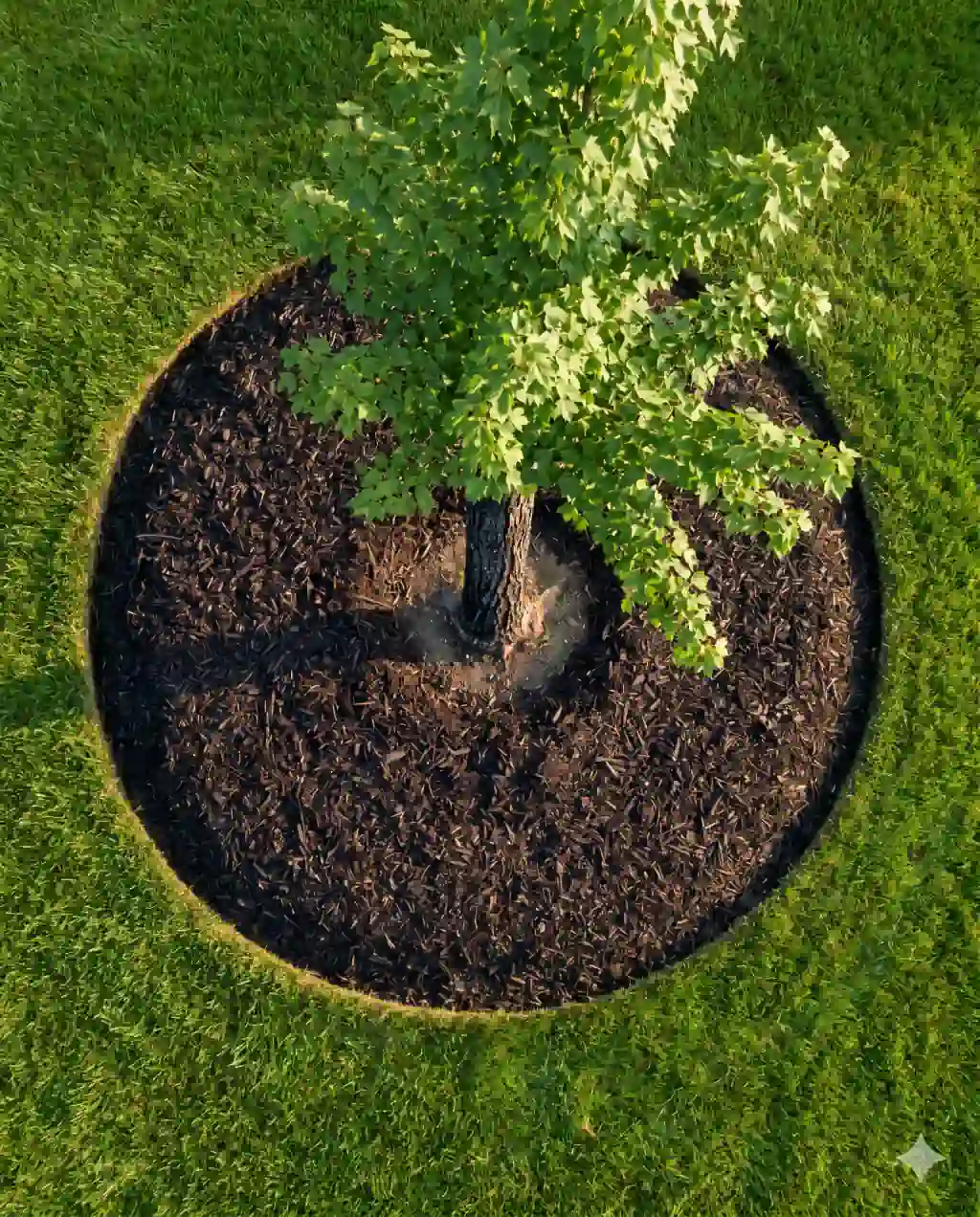
La conformité ANSI signifie que la zone paillée est un anneau (un donut), pas un disque plein. Calculez le cercle extérieur, puis retranchez le cercle intérieur d'écorce nue.
- Surface extérieure = π × (diamètre d'anneau ÷ 2)².
- Surface intérieure = π × ((diamètre du tronc + 6 in de dégagement) ÷ 2)², converti en pieds.
- Surface paillée = extérieure − intérieure.
- Multipliez par la profondeur en pieds (3 in = 0,25 ft, 4 in = 0,333 ft).
- Divisez les pieds cubes par 27 pour les yards cubes.
Exemple : un anneau extérieur de 6 ft avec un tronc de 4 pouces et un tampon de 3 pouces laisse un dégagement intérieur de 10 pouces (0,83 ft). Extérieur 28,27 sq ft − intérieur 0,55 sq ft = 27,72 sq ft. À 3 pouces : 6,93 cu ft = 0,26 cu yd, soit 4 sacs.
ANSI A300-2023 précise que la profondeur du paillis organique sur la zone racinaire ne doit pas dépasser 10 cm et doit rester à l'écart du collet pour permettre les échanges gazeux au cambium.
Tailles courantes de cuvettes d'arbres à la profondeur ANSI recommandée de 4 pouces
| Diamètre d'anneau | Surface (sq ft) | Volume (cu ft) | Sacs 2 cu ft | Yards cubes |
|---|---|---|---|---|
| 3 ft | 7,07 | 2,4 | 2 | 0,09 |
| 4 ft | 12,57 | 4,2 | 3 | 0,16 |
| 6 ft | 28,27 | 9,4 | 5 | 0,35 |
| 8 ft | 50,27 | 16,8 | 9 | 0,62 |
| 10 ft | 78,54 | 26,2 | 14 | 0,97 |
| 12 ft | 113,10 | 37,7 | 19 | 1,40 |
Un anneau de 10 ft est le sweet spot pour un yard cube en vrac à 4 pouces de profondeur. Pour les jeunes arbres (calibre sous 2 in), un anneau de 6 ft suffit et est plus facile à garder sans mauvaises herbes.
Spécifier le paillis comme un arboriste certifié ISA
En commandant pour une cuvette d'arbre, trois spécifications importent au-delà du volume : taille de particule (bois dur déchiqueté de 1–3 pouces respire le mieux), teneur en humidité (le paillis frais chauffe — laissez-le vieillir 30 jours), et pH (évitez le paillis acide testé sous 4,0).